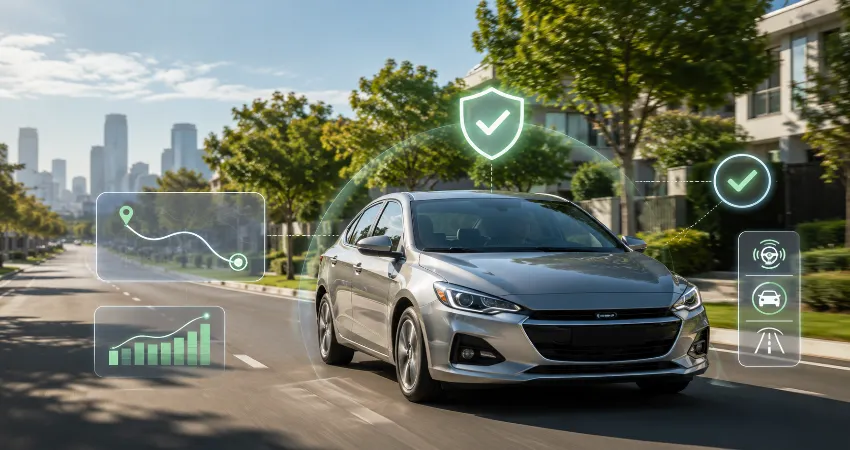
Traditional car insurance pricing often depends on broad factors such as driving history, vehicle type, location, annual mileage, age, and other rating information permitted by state law. Usage-based car insurance takes a more individualized approach. Instead of relying only on historical or demographic information, it can use actual driving data to help determine how a policyholder is priced.
This model is commonly known as usage-based insurance, or UBI, and it is usually powered by telematics technology. Depending on the insurer, data may be collected through a smartphone app, a device connected to the vehicle, or technology already built into the car. The system may evaluate mileage, braking, acceleration, time of travel, cornering, and other driving characteristics.
The important point for drivers is that UBI is not automatically cheaper insurance. It creates an opportunity for driving behavior to play a larger role in pricing. For someone who drives relatively few miles, avoids frequent abrupt maneuvers, limits distractions, and develops consistent habits, that can be valuable. For another driver with long commutes or driving patterns that an insurer considers higher risk, the result may be different.
What Is Usage-Based Car Insurance?
Usage-based car insurance is an auto insurance pricing approach that evaluates information about how a vehicle is actually used. It is sometimes described as telematics insurance, pay-how-you-drive insurance, or pay-as-you-drive insurance, although those terms can refer to slightly different pricing structures. The central idea is the same: actual usage information helps an insurer develop a more personalized view of risk.
The National Association of Insurance Commissioners explains that telematics systems can measure factors including miles driven, time of day, location, rapid acceleration, hard braking, and hard cornering. The exact information collected varies according to the insurer, technology, program, and applicable state requirements.
How Safe Driving Can Affect Your Insurance Cost?
A UBI program generally collects driving information during trips and converts selected information into a score or other rating measurement. Insurers use their own formulas, so there is no universal definition of a perfect telematics score. However, smooth and predictable driving tends to align with the behaviors that many programs encourage.
For example, frequent hard braking may suggest that a driver follows other vehicles too closely or approaches traffic conditions too quickly. Rapid acceleration can indicate aggressive vehicle operation. High mileage increases the amount of time a vehicle is exposed to road risks. Some smartphone-based programs can also identify certain forms of phone interaction while the vehicle is moving.
What Driving Behaviors Are Commonly Monitored?
The details differ substantially between insurers, but common measurements include total mileage, frequency of trips, hard braking, rapid acceleration, cornering, speed-related information, and time of day. Smartphone programs may also evaluate whether the phone is being handled during a trip.
Drivers should not assume every data point displayed in an app directly changes their premium. Some programs provide additional information primarily as driving feedback. Before enrolling, review the insurer’s program terms to determine exactly which factors influence pricing.
Why Low-Mileage Drivers May Have an Advantage?
Drivers who work from home, use public transportation frequently, share a household vehicle, or simply drive less than average may find UBI particularly worth investigating. Traditional insurance applications often rely partly on estimated annual mileage. Telematics can provide insurers with more direct information about actual vehicle usage.
However, mileage should never be evaluated alone. A person who drives very little but frequently makes abrupt stops may not receive the same result as someone who combines low mileage with consistently smooth driving. Think of mileage as one part of an overall driving profile rather than an automatic path to a lower premium.
The Feedback Loop Is an Often-Overlooked Benefit
One of the most useful aspects of telematics is not the potential insurance discount itself. It is the feedback. Many programs allow drivers to review individual trips and identify events such as sudden braking or acceleration. That turns insurance data into a personal driving-improvement tool.
This can reveal habits that are difficult to notice from behind the wheel. A driver may discover, for example, that repeated hard braking happens on the same commute because insufficient following distance has become routine. Research summarized by the Insurance Information Institute has found that many telematics participants reported making safety-related changes to their driving after participating in these programs.
How to Improve Your Driving Profile Naturally?
The best strategy is not to drive specifically for an app. It is to develop habits that make ordinary driving smoother and more predictable. Increase following distance so normal traffic changes can be handled gradually. Look several vehicles ahead rather than focusing only on the bumper immediately in front of you. Begin slowing earlier when approaching signals, intersections, or congestion.
Avoid unnecessary rapid acceleration and keep your phone out of your hands while driving. If possible, combine errands into fewer trips and reconsider unnecessary journeys. These behaviors can potentially improve a telematics profile while also supporting safer everyday driving.
Can Usage-Based Insurance Increase Your Rate?
Possibly. This is one of the most important questions to answer before enrolling. Program rules vary by insurer and state. Some UBI programs are structured primarily around discounts, while others can use telematics results to produce a higher renewal rate when driving information indicates greater risk.
Progressive, for example, states that its Snapshot program can result in a discount for many participants but may produce a higher rate for riskier driving in applicable states and circumstances. This illustrates why drivers should read the specific terms rather than assuming participation can only reduce their bill.
Privacy Should Be Part of the Decision
UBI requires a tradeoff: greater personalization generally requires sharing more driving information. Before signing up, determine exactly what information is collected, whether GPS location is recorded, how long information is retained, who can access it, and how it may be used.
Privacy rules and disclosure requirements can also vary by jurisdiction. Regulators and consumer insurance resources have specifically identified privacy as an important consideration with telematics because these systems may collect detailed information about vehicle use.
Who Is a Good Candidate for Usage-Based Insurance?
UBI may be worth considering for drivers with relatively low annual mileage, predictable schedules, smooth driving habits, limited late-night travel, and little or no handheld phone use while driving. It may also appeal to people who enjoy receiving measurable feedback and are willing to adjust habits over time.
Drivers with unpredictable work schedules, frequent nighttime travel, very high annual mileage, multiple people regularly using the same vehicle, or strong concerns about sharing driving data should study the details more carefully before enrolling.
What to Check Before You Enroll?
Do not evaluate a telematics program only by the largest advertised discount. Ask what behaviors influence the score, whether poor results can increase your premium, how long the monitoring period lasts, when savings are applied, how passenger trips are distinguished from driver trips, and what happens if the app records a journey incorrectly.
Also compare the total insurance quote. A large percentage discount from an expensive starting premium may still cost more than a smaller discount from another insurer. Coverage limits, deductibles, customer service, exclusions, and the final premium matter more than the telematics discount percentage by itself.
FAQs About Usage-Based Car Insurance
1. Is usage-based car insurance the same as traditional car insurance?
No. The underlying coverage may be similar, but the pricing method can be different. Traditional policies rely heavily on established rating factors, while UBI adds actual driving or mileage information collected through telematics. The importance of that information varies between insurers and states.
2. Do I need a special device in my car?
Not always. Many modern programs operate through smartphone apps. Others use a small device connected to the vehicle’s diagnostic port, a Bluetooth beacon, or technology integrated into the vehicle. The available method depends on the insurer and vehicle.
3. Can safe driving guarantee a lower premium?
No. Safe driving may improve your opportunity for savings, but insurance pricing includes multiple factors. The insurer’s scoring method, state rules, mileage, baseline premium, policy characteristics, and collected driving information can all influence the final result.
4. Does hard braking always hurt my driving score?
An occasional emergency stop does not necessarily define your overall driving profile. Insurers generally evaluate patterns across collected data. Frequent abrupt braking, however, may indicate driving habits that the program associates with increased risk.
5. Does UBI track where I drive?
Some programs collect GPS or location-related information, while others may use different or more limited data. Never assume location is excluded. Review the privacy notice and telematics agreement before enrollment to understand exactly what the insurer collects.
6. Is usage-based insurance good for people who work from home?
It can be. Someone who works from home may accumulate fewer annual miles than a daily commuter, potentially making a mileage-sensitive program attractive. Actual savings still depend on the insurer’s pricing structure and the person’s overall driving profile.
7. Can several family members use a car enrolled in UBI?
Usually a program will have procedures for vehicles with multiple drivers, but the details vary. Smartphone systems may require trip classification or driver identification. Households with several drivers should understand these rules before relying on an estimated discount.
8. How long does an insurer monitor driving?
There is no universal monitoring period. Some programs collect information for a defined evaluation period, while others continue collecting information and update pricing at renewal. Review the program terms so you know whether participation represents temporary monitoring or an ongoing arrangement.
9. Should I choose insurance based only on the UBI discount?
No. Compare the complete policy price and coverage. Liability limits, comprehensive and collision coverage, deductibles, claims service, exclusions, and other policy features can be more important financially than a single discount.
10. What is the smartest way to decide whether UBI is right for me?
Start by reviewing your normal driving rather than changing it temporarily. Estimate your mileage, commute schedule, nighttime driving, phone habits, and typical road conditions. Then read the insurer’s telematics rules and compare the final quote with conventional policies offering similar coverage.
Conclusion
Usage-based car insurance gives drivers an opportunity to have actual driving behavior play a greater role in insurance pricing. It can be particularly appealing to low-mileage and consistently safe drivers, but potential savings should be considered alongside program rules, privacy, data collection, and the possibility of future premium changes.
The strongest approach is to compare the complete policy, understand what the insurer measures, and treat telematics feedback as a tool for developing safer, smoother driving habits rather than simply chasing a discount.