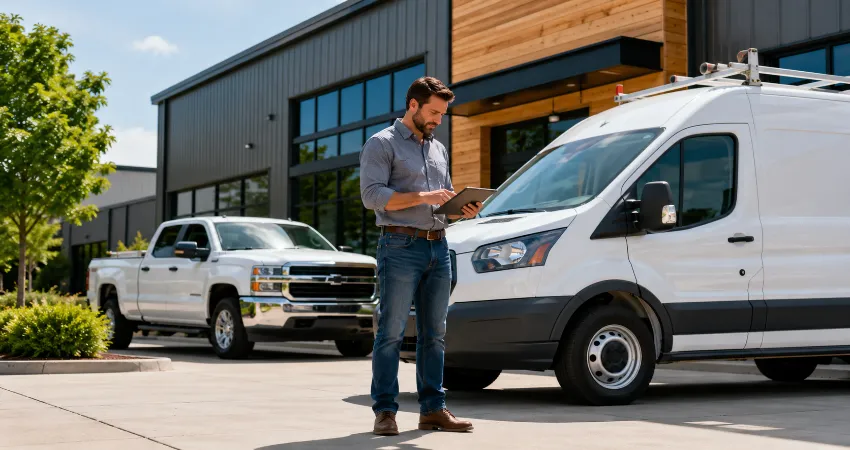
Commercial vehicles can create some of the largest everyday financial risks a small business faces. A single company car, service van, pickup truck, or delivery vehicle may spend hundreds of hours on public roads each year. Because those vehicles are being used for business purposes, a standard personal auto policy may not provide the protection the business actually needs.
Commercial auto insurance rates can also be difficult to predict. Two businesses operating similar vehicles can receive very different quotes because insurers evaluate much more than the vehicle itself. Driver records, mileage, business activity, location, coverage limits, previous claims, vehicle value, and even where vehicles are stored overnight can influence the premium.
For small business owners, the useful question is therefore not simply, “What is the average commercial auto insurance rate?” A better question is, “Which factors are causing my rate, and which of those factors can I control?” Understanding that distinction can help an owner make better insurance decisions instead of automatically choosing the lowest quote.
How Much Does Commercial Auto Insurance Cost?
Current small-business insurance data provides a useful starting point. Insureon reports that its small-business customers pay an average of about $245 per month for commercial auto insurance, or roughly $2,942 annually. However, annual premiums in its customer data range from less than $375 to more than $16,000. That enormous range demonstrates why a national average should be treated as a reference point rather than a prediction of what an individual business will pay.
Approximately 40% of Insureon’s small-business customers pay less than $200 per month. Businesses operating heavier vehicles, driving greater distances, working in higher-risk industries, or employing several drivers may pay considerably more.
Why Commercial Auto Rates Vary So Much?
Insurance companies price policies according to expected risk. Underwriters consider both how likely a claim is to occur and how expensive a future claim could become. A consultant who drives one sedan to occasional client meetings presents a very different exposure from a contractor operating several trucks between job sites every day.
This means owners should avoid comparing premiums without comparing the underlying risks and coverage. A $150 monthly policy and a $300 monthly policy may provide different liability limits, deductibles, vehicle protection, driver eligibility, and endorsements. Price alone does not show which policy offers better value.
Vehicle Type and Value Have a Major Impact
The vehicles themselves are among the most important rating factors. Sedans and smaller passenger vehicles generally present different repair and liability exposures than box trucks, heavy pickups, specialized vans, trailers, or other commercial vehicles.
Vehicle value matters as well. A newer vehicle equipped with expensive electronics, cameras, sensors, and specialized equipment can cost considerably more to repair after an accident. Industry research from the Insurance Information Institute has highlighted continuing pressure from vehicle and parts replacement costs. For a business owner, buying a more expensive work vehicle can therefore increase more than the monthly loan payment. It may also affect the insurance budget.
Driver Records Can Raise or Lower Your Premium
A commercial auto insurer may evaluate the driving history of employees authorized to operate insured vehicles. Accidents, serious traffic violations, license problems, and repeated driving incidents can increase the perceived risk of the entire account.
This is one reason a driver-screening process can be financially valuable even for a very small company. Before allowing an employee to regularly operate a business vehicle, owners should verify licensing and consider reviewing motor vehicle records where legally appropriate. Periodic reviews can identify changes that might otherwise remain unnoticed until renewal or a claim occurs.
Business Location Changes the Rate
Commercial auto rates can vary significantly by state and local area. Traffic density, accident patterns, repair expenses, medical costs, theft levels, weather exposures, legal environments, and the number of uninsured drivers can all influence regional insurance costs.
For example, Insureon’s recent customer data showed substantial differences among state averages, with some states costing well over twice as much as others. Owners operating across state lines should therefore discuss where vehicles are primarily garaged and where they regularly travel rather than assuming one location determines every part of the policy.
Mileage and Vehicle Use Matter More Than Many Owners Realize
Insurers want to understand what the vehicle actually does. Occasional trips to a bank or client office generally create a different exposure from daily deliveries, transporting tools between construction sites, or spending most of the working day on the road.
Owners should provide accurate mileage and usage information. Underestimating vehicle use simply to obtain a lower initial quote can create problems later. Accurate information allows insurers to price the real operation and helps reduce the possibility of unexpected coverage questions after an accident.
Coverage Limits Directly Affect Commercial Auto Insurance Rates
Liability coverage can pay for covered injuries, property damage, and related legal expenses when the insured business is responsible for an accident. Higher liability limits generally increase premiums because the insurer is accepting a larger potential financial obligation.
The cheapest legal minimum is not automatically the best business decision. Owners should consider the value of the company, contractual requirements, vehicle activity, potential accident severity, and assets that could be exposed. Businesses with significant liability concerns may also discuss commercial umbrella coverage with a qualified insurance professional.
Collision and Comprehensive Coverage Add Another Cost Decision
Liability coverage primarily addresses damage or injuries caused to others. Businesses may also need protection for their own vehicles. Collision coverage generally addresses covered vehicle damage from crashes, while comprehensive coverage may address events such as theft, vandalism, fire, severe weather, and certain other losses.
For a financed or leased vehicle, these coverages may be required by the lender or leasing company. For an older vehicle owned outright, the business should compare its current value with the cost of carrying physical damage coverage and the financial impact of replacing the vehicle without insurance.
Deductibles Can Change the Premium
A deductible is the amount the policyholder is responsible for paying toward a covered loss before applicable insurance benefits take over. Choosing a higher deductible can sometimes reduce the premium because the business assumes a greater portion of smaller losses.
However, a higher deductible only makes sense when the company has enough available cash to pay it unexpectedly. A deductible that looks attractive during renewal can become a problem if several vehicles are damaged within a short period.
Claims History Can Follow the Business
Previous claims help insurers estimate future risk. A pattern of collisions, property damage, or other auto losses can lead to higher premiums or fewer available coverage options. Maintaining vehicles properly, establishing clear driving rules, investigating incidents, and addressing recurring safety problems can therefore influence insurance costs over the long term.
Recent industry research has also found that increasing claim severity has been a significant challenge for commercial auto insurers. The average financial impact of claims has risen even when accident frequency has not increased at the same pace. Higher repair expenses and liability costs eventually influence premiums throughout the market.
Do You Need Hired and Non-Owned Auto Coverage?
A common small-business coverage gap occurs when employees use vehicles the company does not own. Examples include an employee using a personal car for a company errand or a business renting a vehicle temporarily.
Hired and non-owned auto coverage, often called HNOA, can help address liability exposures involving certain rented, hired, or employee-owned vehicles used for business purposes. Travelers notes that a traditional commercial auto policy does not automatically cover every vehicle a business does not own. Owners should disclose these arrangements when requesting coverage rather than assuming an employee’s personal policy fully protects the company.
A Practical Way to Evaluate Commercial Auto Quotes
Instead of asking insurers for the lowest possible price, request comparable quotes using the same vehicles, drivers, liability limits, deductibles, and major coverage options. Then review what is included and excluded.
A useful approach is to calculate the annual premium per vehicle while remembering that vehicles may have different risk profiles. Also review deductibles, liability limits, uninsured or underinsured motorist protection where available, physical damage coverage, hired and non-owned exposure, and any important endorsements. This gives the owner a more meaningful comparison than monthly price alone.
How Small Businesses Can Work Toward Lower Rates?
Businesses cannot control every insurance pricing factor, but they can influence several of them. Maintaining strong driver standards, reviewing driving records, preventing distracted driving, servicing vehicles regularly, reporting accurate mileage, reducing unnecessary vehicle use, and reviewing claims can improve the company’s overall risk profile.
It is also sensible to compare equivalent coverage periodically. Commercial insurance pricing and underwriting preferences differ among carriers. The goal should not be to remove important protection merely to reduce the premium, but to eliminate unnecessary costs while preserving coverage for losses the business could not comfortably absorb itself.
FAQs About Commercial Auto Insurance Rates
1. What is the average commercial auto insurance rate for a small business?
Recent Insureon customer data places the average at approximately $245 per month, or around $2,942 annually. Individual premiums can be dramatically lower or higher. Vehicle type, state, mileage, industry, drivers, coverage limits, deductibles, and previous claims all contribute to the final rate.
2. Why is commercial auto insurance more expensive than personal auto insurance?
Commercial vehicles often spend more time on the road, may be operated by multiple drivers, and can create larger liability exposures. Commercial policies may also carry higher limits and cover vehicles used in activities that personal policies were not designed to insure.
3. Does adding an employee driver increase the premium?
It can. Insurers may review the driver’s age, experience, license status, accident history, violations, and expected vehicle use. Adding a driver with a clean record may have a smaller impact than adding someone with significant driving incidents.
4. Does the number of business vehicles affect rates?
Yes. Adding vehicles increases the insurer’s overall exposure, although pricing is not always a simple multiplication of the first vehicle’s premium. Each vehicle’s value, use, location, driver assignment, mileage, and coverage can affect its contribution to the policy cost.
5. Can a higher deductible reduce commercial auto premiums?
A higher deductible may reduce the premium for certain coverages because the business accepts more of the initial financial loss. Owners should balance potential savings against their ability to pay the deductible immediately after an accident.
6. Will one accident automatically increase my commercial auto rate?
Not necessarily, because insurers consider the circumstances of the accident, claim amount, fault, broader claims history, and their own underwriting rules. However, accidents can affect future pricing, especially when they are part of a recurring loss pattern.
7. Can employees use personal cars for company business?
They can, but doing so creates an insurance issue that should be reviewed carefully. A business may still face liability after an employee causes an accident while performing work. Hired and non-owned auto coverage may help address certain exposures involving employee-owned or rented vehicles.
8. Should a business choose only the minimum liability limit?
Not automatically. Minimum requirements establish a legal baseline, not necessarily an appropriate risk-management level. A serious accident can create expenses far beyond minimum limits. The business’s assets, operations, contracts, vehicle use, and potential liability should all be considered.
9. How often should commercial auto insurance be reviewed?
At minimum, owners should review coverage around renewal. A review is also appropriate after purchasing vehicles, adding drivers, changing business activities, entering new states, increasing mileage, or experiencing significant growth. Insurance should reflect current operations rather than last year’s business.
10. What is the most effective way to control commercial auto insurance costs?
There is no single solution. Strong driver selection, safe-driving policies, regular vehicle maintenance, accurate policy information, thoughtful deductibles, appropriate limits, claims management, and comparisons of equivalent coverage can all contribute. Long-term risk management is usually more sustainable than simply reducing coverage.
Conclusion
Commercial auto insurance rates reflect the real-world risks created by vehicles, drivers, locations, business activities, and potential claim costs. Although current averages provide a useful benchmark, they cannot predict what every small business will pay.
Owners can make better decisions by understanding the factors behind their premium, comparing policies on equal terms, managing driver and vehicle risks, and choosing coverage based on the financial exposure their business can realistically handle.